Monday, 29 July 2013

Sunday, 28 July 2013
Stealth aircraft
.
Stealth aircraft are designed to avoid detection using a variety of advanced technologies that reduce reflection/emission of radar,infared, visible light, radio frequency(RF0 spectrum, and audio, collectively known as stealth technology. Development of stealth technology likely began in German during World War II. Well-known modern examples of stealth aircraft include the United States' F-117 Nighthawk (1981–2008), the B-2 Spirit, the F-22 Raptor, and the F-35 Lightning II.
While no aircraft is totally invisible to radar, stealth aircraft make it difficult for conventional radar to detect or track the aircraft effectively, increasing the odds of a successful attack. Stealth is the combination of passive low observable (LO) features and active emitters such as Low Probality of intercept radar, radios and laser designators. These are usually combined with active defenses such as chaff,flares, and ECM. It is accomplished by using a complex design philosophy to reduce the ability of an opponent's sensors to detect, track, or attack the stealth aircraft. This philosophy also takes into account the heat, sound, and other emissions of the aircraft as these can also be used to locate it.
Full-size stealth combat aircraft demonstrators have been flown by the United States (in 1977), Russia (in 2010) and China (in 2011).]The US military has adopted three stealth designs, and is preparing to adopt the Lockheed Martin F-35 Lightning II.
Most recent fighter designs will claim to have some sort of stealth, low observable, reduced RCS or radar jamming capability, but there has been no air to air combat experience against stealth aircraft

F22-Raptor
The Lockheed Martin/Boeing F-22 Raptor is a single-seat, twin-engine fifth-generation supermaneuverable fighter aircraft that uses stealth technology. It was designed primarily as an air superiority fighter, but has additional capabilities that include ground attack, electronic warfare, and signals intelligence roles.Lockheed Martin Aeronautics is the prime contractor and is responsible for the majority of the airframe, weapon systems and final assembly of the F-22. Program partner Boeing Defense, Space & Security provides the wings, aft fuselage, avionics integration, and training systems.


Specification
General characteristics
- Crew: 1
- Length: 62 ft 1 in (18.90 m)
- Wingspan: 44 ft 6 in (13.56 m)
- Height: 16 ft 8 in (5.08 m)
- Wing area: 840 ft² (78.04 m²)
- Airfoil: NACA 64A?05.92 root, NACA 64A?04.29 tip
- Empty weight: 43,340 lb (19,700 kg[6][312])
- Loaded weight: 64,460 lb (29,300 kg[N 5])
- Max. takeoff weight: 83,500 lb (38,000 kg)
- Powerplant: 2 × Pratt & Whitney F119-PW-100 Pitch Thrust vectoring turbofans
- Dry thrust: 23,500 lb[315] (104 kN) each
- Thrust with afterburner: 35,000+ lb[6][315] (156+ kN) each
- Fuel capacity: 18,000 lb (8,200 kg) internally,[6][312] or 26,000 lb (11,900 kg) with two external fuel tanks.[6][312] About 3,050 gal or 20,333 lb JP-8 (without additions) internally.[316]
Performance
- Maximum speed:
- At altitude: Mach 2.25 (1,500 mph, 2,410 km/h) [estimated][150]
- Supercruise: Mach 1.82 (1,220 mph, 1,963 km/h)[150]
- Range: >1,600 nmi (1,840 mi, 2,960 km) with 2 external fuel tanks
- Combat radius: 410 nmi (with 100 nmi in supercruise)[311] (471 mi, 759 km)
- Ferry range: 2,000 mi (1,738 nmi, 3,219 km)
- Service ceiling: 65,000 ft (currently restricted to 44,000 ft, sans vests)[317] (19,812 m)
- Rate of climb: 40,000+ ft/min[citation needed] (200 m/s)
- Wing loading: 77 lb/ft² (375 kg/m²)
- Thrust/weight: 1.09 (1.26 with loaded weight & 50% fuel)
- Maximum design g-load: -3.0/+9.0 g[150]
FATHERS OF AVIATION
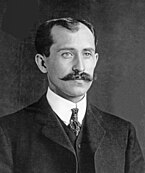
The fathers of aviation The Wright Brothers,they was a true pioneer of aeroplanes in the world.Orville was born in 1871 August 19 and Wilbur that was born 1876 April 16,they were a American inventor and aviation pioneer that should be credited by our generation.

Orville Wright
From 1905 and 1907, the brothers developed their flying into the first practical fixed-wing aircraft.Although not the first to build and fly experimental aircraft, the Wright brothers were the first to invent aircraft controls that made fixed-wing powered flight possible.
Wilbur Wright
They gained the mechanical skills essential for their success by working for years in their shop with printing presses, bicycles, motors, and other machinery. Their work with bicycles in particular influenced their belief that an unstable vehicle like a flying machine could be controlled and balanced with practice
Sikorsky Ilya Muromets
The Ilya Muromets refers to a class of Russian pre- world war-one large four-engine commercial airliners and heavy military bombing aircraft used during World War I by the Russian Empire.The aircraft series was named after IIya Muromets, a hero from Russian mythology.The series was based on the Russky Vityaz or Le Grand, the world's first four-engined aircraft, designed by Igor Sikrosky The Ilya Muromets aircraft as it appeared in 1913 was a revolutionary design, intended for commercial service with its spacious fuselage incorporating a passenger saloon and washroom on board.During World War I, it became the first four-engine bomber to equip a dedicated strategic bombing unit.This heavy bomber was unrivaled in the early stages of the war, as theCentral Power had no aircraft capable enough to challenge it until much later, with the 1916-17 origin Zepplelin Staaken R.VI, the only example of any of the Imperial German Riesenflugzeug airframe designs to be produced in any quantity during World War I.

The Ilya Muromets (Sikorsky S-22) was designed and constructed by Igor Sikorsky at the Russo-Baltic Carriage Factory (RBVZ) in Riga in 1913. It was based on his earlier S-21 Russky Vityaz, which started out as the twin-engined Le Grand, then as the twin tandem engined Bolshoi Baltisky before placing all four of the Baltisky's engines in a tractor configuration along the lower wing's leading edge to create the Russky Vityaz — which had played an important role in the development of Russian aviation and the multi-engine aircraft industries of the world.

The Ilya Muromets refers to a class of Russian pre- world war-one large four-engine commercial airliners and heavy military bombing aircraft used during World War I by the Russian Empire.The aircraft series was named after IIya Muromets, a hero from Russian mythology.The series was based on the Russky Vityaz or Le Grand, the world's first four-engined aircraft, designed by Igor Sikrosky The Ilya Muromets aircraft as it appeared in 1913 was a revolutionary design, intended for commercial service with its spacious fuselage incorporating a passenger saloon and washroom on board.During World War I, it became the first four-engine bomber to equip a dedicated strategic bombing unit.This heavy bomber was unrivaled in the early stages of the war, as theCentral Power had no aircraft capable enough to challenge it until much later, with the 1916-17 origin Zepplelin Staaken R.VI, the only example of any of the Imperial German Riesenflugzeug airframe designs to be produced in any quantity during World War I.
| Role | Heavy Bomber |
|---|---|
| National origin |  Russian Empire Russian Empire |
| Manufacturer | Rusco Baltic Wagon Company |
| Designer | Igor Sikrosky |
| First flight | 11 December 1913 |
| Introduction | 1913 |
| Retired | 1922 |
| Primary user | Imperial Russian Air Force |
| Number built | 85+ |
| Developed from | Sikorskyi Rus'ky vityaz |
Following the February Revolution in 1917, the Ilya Muromets bombers continued to fly with the Russian Imperial Army but others were seized by the provisional government with pilots also defecting to the Ukrainian squadron of Hetman and General Pavlo Skoropadsky, with at least one Ilya Muromets being flown by Polish forces. The remainder of the aircraft flew with the Red Army until mid-1919.
Subscribe to:
Comments (Atom)